Voice of Customer Surveys: Hear What Customers Actually Mean, Not Just What They Type
Spoken answers run 2.5x longer than typed ones and carry tone a transcript drops. How to run a voice of customer survey, with a 10-question bank to copy.
The short version
- Most voice of customer programmes contain no voice at all: scores, typed comments, reviews and tickets. The term came from product development, where it meant listening to customers in depth.
- Spoken answers carry more: in a 2024 randomised smartphone experiment (N = 1,001), voice answers averaged 54.7 words against 21.5 typed, with more topics covered.
- Tone is signal, not noise. In a 2017 experiment, listeners judged emotions least accurately when the same words were read by a flat synthetic voice, and most accurately from the real voice alone.
- Use voice for one or two episode questions per survey, keep scores and choices as taps, and always offer a text box beside the microphone, because voice-only questions lose respondents.
Most voice of customer programmes contain no voices. They contain scores, typed comments, star ratings and support tickets, all of it text. A voice of customer survey, taken literally, asks customers to speak, and the evidence says they then say about 2.5 times as much as they type.
Your VoC data is probably text all the way down. That is a fixable gap. Below we cover the four standard VoC methods, what each one hears and misses, where a spoken answer adds signal that text cannot carry, and a question bank you can paste into your next customer feedback form.
A voice of customer survey collects customers' needs and frustrations in their own words. To write one, ask one or two questions about a specific recent episode, such as "What nearly made you cancel?", and let customers answer by voice or text. Keep scores and choices as quick taps, and put the open question after them.
Voice of customer started as listening, then became typing
The phrase has an origin worth knowing. In 1993, Abbie Griffin and John Hauser published "The Voice of the Customer" in Marketing Science. They studied the first stage of Quality Function Deployment, the process product teams used to turn customer needs into engineering targets. Their questions were practical: how many customers to interview, how many analysts should read the transcripts, how many needs a team misses, and whether focus groups beat one-on-one interviews.
In that world, the voice of the customer was literal. Teams sat with customers, recorded what they said, and read the transcripts closely. The method was slow and expensive, and it produced depth.
Scale pushed VoC toward scores and text boxes
Then customer feedback moved online, and the cheapest data won. A 0 to 10 score costs a respondent two seconds. A typed comment box costs nothing to add. Over time, most VoC dashboards became a score trend with a word cloud underneath.
We think that trade went too far. A score tells you something moved. It rarely tells you why, and the typed comment under it is usually one line. We cover that empty-box problem in why the "any other comments" question stays empty.
The founder of NPS asked for reasons too
Even the most famous single-number metric was never meant to stand alone. In The Ultimate Question 2.0, Fred Reichheld and Rob Markey wrote that companies should ask at least one follow-up after the recommend score: "What is the primary reason for your score?". They described it as the way to hear customers' reasons in their own words. We go deeper on that question in designing the NPS follow-up question.
The 4 voice of customer methods, and what each one misses
Every VoC method is a trade between depth, scale and effort. None is complete on its own, and the honest comparison includes where the typed and scored options win.
| Method | What you get | What you lose | Where it wins |
|---|---|---|---|
| Customer interviews | Depth, follow-up questions, tone | Scale; each one costs an hour of someone's time | Discovery, before you know what to ask |
| Scored surveys (NPS, CSAT) | A trend you can track every month | Almost all reasons | Spotting that something changed, and where |
| Typed open questions | Reasons at scale | Length, tone and the second reason | Fast-to-scan comments when you need searchable text |
| Online reviews | Unprompted, public opinions | Representativeness; skews to strong feelings | Learning the words customers use about you |
| Support tickets | Real problems with timestamps | Anyone who never complained | Ranking defects by how often they hurt people |
| Spoken survey answers | Interview-like stories from hundreds of people | Some respondents, who will not talk aloud | The why behind a score, at survey scale |
The typed open question deserves credit. It is easy to search, cheap to analyse, and nobody has to find a quiet room to answer it. If your team will never listen to a recording, a text box is the better choice. We would still argue most teams underuse the bottom row.
What a spoken answer carries that a typed one cannot
Length is the obvious difference. The randomised experiment by Höhne, Gavras and Claassen found spoken answers averaged 54.7 words against 21.5 typed, and covered more topics. We analyse that study in full in our post on spoken answers, including its large drop-off cost.
The same paper reports a detail VoC teams should notice. It found no differences in sentiment between voice and text answers, once both were in text form. So the extra signal in a spoken answer is not hidden in more emotional words. It lives in the length, the extra topics, and the sound itself.
Tone carries emotion that listeners can decode
The science of vocal emotion is old and well replicated. Juslin and Laukka reviewed 104 studies of vocal expression and found that discrete emotions were communicated to listeners through emotion-specific patterns of acoustic cues. In plain terms: how something is said carries information about how the speaker feels, and people can hear it.
For VoC, that matters in small, practical ways. "It's fine" said flatly and "it's fine" said with a laugh are different answers. A typed survey records them as the same string.
The same words, read flatly, lose the signal
The sharpest evidence comes from Michael Kraus at Yale. Across five experiments with 1,772 participants, people judged others' emotions more accurately from voice alone than from video with sound, or from video alone.
His fifth experiment is the one we would show any VoC team. Listeners heard recorded conversations between friends. One group heard the real voices. Another heard a monotone synthetic voice read the exact transcript. Same words, no human tone. That group judged the speakers' emotions least accurately of all four conditions.
Two caveats belong next to that chart. The participants were online panel workers judging friends teasing each other, not customers talking about a product. And a 2018 comment by Rossiter in the same journal, "Voice-only does not meaningfully improve detection of emotions", argued the voice-only advantage is too small to matter in practice. The synthetic-voice gap was the largest in experiment 5, but treat the direction as the lesson, not the exact size.
Hesitation and confidence are audible
Listeners also read certainty from speech. Brennan and Williams studied prosody and filled pauses as cues to a speaker's state of knowing, the "um" before a guess. In customer research, the pause before "yes, I'd probably pay for that" is often the most honest part of the answer.
Hearing also changes how much credit listeners give the speaker. Schroeder and Epley found that evaluators rated job candidates as more competent and intelligent when they heard a pitch than when they read the same pitch. Their setting was hiring, not feedback. The lesson transfers: a customer heard is a customer taken more seriously in the room where decisions get made.
How to design a voice of customer survey
The design job is to collect stories without losing people. Spoken questions cost more effort than taps, so you spend them only where reasons matter.
- 1Pick the decision the survey must informPricing, onboarding, a churn spike. One decision per survey keeps the questions honest.
- 2Choose a moment, not a listSend it right after a real event: first week, a support ticket closed, a cancellation, a renewal.
- 3Start with two or three tapsA score, a choice of plan or use case. These are fast, and they let you slice the stories later.
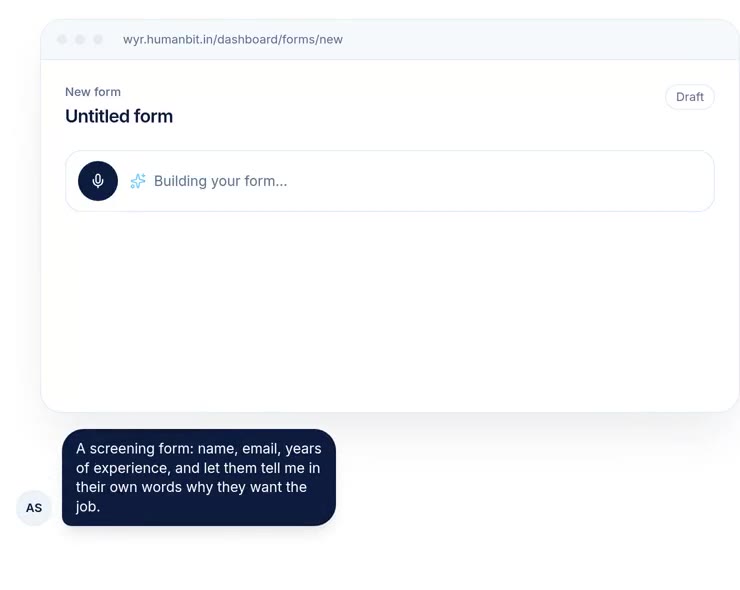
- 4Ask one episode question that takes a spoken answer"Walk me through the last time this was frustrating." State a limit: up to 2 minutes, any language.
- 5Put a text box beside the microphonePeople on a train or in an open office will type. Do not lose them.
- 6Listen to a sample before you summarisePlay 20 recordings end to end before anyone builds a chart. Then tag themes and pick quotes.
On step 5: in our own builder, the text fallback on a voice question is a switch, and it is off by default. Turn it on for any customer audience. The reason is the drop-off evidence: in the Höhne experiment, about half the people assigned to voice-only answers broke off before the questions began.
Voice of customer survey questions: a question bank
Good VoC questions ask about an episode. "How do you feel about our onboarding?" invites a verdict. "Tell me about your first day using us" invites a story, and stories contain the details you can act on.
| Moment | Question | Answer type | What you learn |
|---|---|---|---|
| After signup | "What were you trying to get done when you signed up today?" | Voice or text | The job customers hire you for, in their words |
| First week | "Walk me through the first time you used it, start to finish." | Voice or text | Where onboarding confuses people |
| First week | "How easy was it to get started?" | Rating, 1 to 5 | A trend to watch over releases |
| After purchase | "What nearly stopped you from buying?" | Voice or text | Objections your sales page misses |
| After purchase | "What did you try before us, and why did you stop?" | Voice or text | The real competitor, often a spreadsheet |
| After support | "Did we solve the problem?" | Yes or no | A clean resolution rate |
| After support | "What happened before you contacted us?" | Voice or text | The defect behind the ticket |
| Quarterly | "How likely are you to recommend us to a friend or colleague?" | 0 to 10 scale | The NPS trend |
| Quarterly | "What is the main reason for your score?" | Voice or text | The reason behind the number |
| Cancellation | "What changed that made you leave?" | Voice or text | The trigger, not just the category |
Ask about one episode, not an average
People are bad at averaging their own experience and good at telling one story. "Usually" questions get vague answers. "Last time" questions get names, steps and feelings. If an answer surprises you, the episode framing also makes it easy to check against your logs.
Keep scores and choices as taps
Do not ask people to speak a number. Ratings, plans and yes or no answers are faster to tap and easier to analyse. Voice is for reasons. A form that mixes the two well feels short, even when it collects a lot. For multilingual customers, invite them to answer in whichever language they think in; we cover that in collecting answers in Hindi, Tamil or any language.
Turning recordings into decisions
A folder of audio is not insight. Plan the analysis before you send the survey, because the cost is real and it lands on someone's calendar.
Under about 100 answers, listen to all of them. It takes an afternoon, and you hear what transcripts drop. Above that, sample: listen to 20 to 30 end to end, write themes, then skim the rest for those themes. Tag each answer with its theme next to the respondent's score, so you can see which reasons cluster among unhappy customers.
Be clear about what our own product does here. Would You Rather stores each recording next to the respondent's other answers, and can sync everything to a spreadsheet with audio links; see sending form responses to Google Sheets. It does not transcribe answers or score their sentiment. If you need transcripts for search, export the audio links and run them through a speech-to-text engine you trust.
Our view is that the listening is the point. A team that hears 20 customers explain a churn reason will act faster than a team that reads a bar chart of the same reason. That is a belief, not a measured result, and you can test it on your own team.
Where voice adds little, and where the evidence is weak
Voice is not always worth the cost. There are clear cases where a typed or scored question is the better tool, and the evidence base has gaps you should know about.
First, drop-off. Voice-only questions lose many respondents, and the people who leave may differ from those who stay. If your customers are mostly at desks in open offices, expect more typing than talking. Second, questions with short factual answers gain nothing from voice. "Which plan are you on?" should never be a recording.
Third, the research on tone comes mostly from lab studies of emotion between friends or strangers, not from product feedback. We are extrapolating from it, and you should treat the tone argument as plausible rather than proven for VoC. Fourth, analysis effort scales with volume. Ten thousand recordings with nobody to listen are worse than ten thousand typed lines someone can search.
Finally, privacy. A voice is identifying in a way a typed comment is not. Tell customers how recordings are stored and who hears them, and do not ask for voice where anonymity is the point.
How to run your first voice of customer survey this week
Pick one moment that matters this quarter: cancellations, first week, or renewals. Write one episode question for it, add two taps before it, and offer voice beside a text box. Send it to the next 50 customers who hit that moment.
Then hold one meeting where the team listens to 10 recordings together before anyone opens a dashboard. Note which themes come up and which surprised you. If you already run NPS, add the spoken reason question to it instead; it is the smallest possible change, and we explain why in our NPS follow-up guide. For the typing side of the argument, see why typed open answers come back short.
References
- Griffin, A. and Hauser, J. R., The Voice of the Customer, Marketing Science, 1993. Used for the origin of the term and the questions the method addressed (abstract only).
- Höhne, J. K., Gavras, K. and Claassen, J., Typing or Speaking? Comparing Text and Voice Answers to Open Questions on Sensitive Topics in Smartphone Surveys, Social Science Computer Review, 2024. Used for answer length, topics, the absence of sentiment differences, and break-off.
- Kraus, M. W., Voice-Only Communication Enhances Empathic Accuracy, American Psychologist, 2017. Used for the five experiments and the experiment 5 synthetic voice results.
- Rossiter, J. R., Voice-only does not meaningfully improve detection of emotions: Comment on Kraus (2017), American Psychologist, 2018. Used as the critique of the effect size in reference 3.
- Juslin, P. N. and Laukka, P., Communication of emotions in vocal expression and music performance, Psychological Bulletin, 2003. Used for the review of 104 vocal expression studies.
- Brennan, S. E. and Williams, M., The Feeling of Another's Knowing: Prosody and Filled Pauses as Cues to Listeners about the Metacognitive States of Speakers, Journal of Memory and Language, 1995. Used for the point that hesitation signals certainty (title and scope only).
- Schroeder, J. and Epley, N., The Sound of Intellect, Psychological Science, 2015. Used for heard versus read evaluations.
- Reichheld, F. and Markey, R., The Ultimate Question 2.0, advance excerpt, Bain and Company, 2011. Used for the original recommend question and its follow-up.
The weakest point in this source base: none of the tone and emotion studies used customer feedback, so the case that tone improves VoC decisions is an inference from lab research, not a measured result.
Questions people ask
What is a voice of customer survey?
A voice of customer survey collects customers' own descriptions of their needs, experiences and frustrations, usually alongside a few scores. The term comes from product development, where voice of the customer meant identifying and prioritising needs in customers' own words. Today most VoC surveys are typed forms. A spoken version lets customers answer the open questions by recording their voice in the browser, which captures tone and hesitation as well as words.
What are good voice of customer survey questions?
Good VoC questions ask about a specific episode rather than a general opinion. Examples: 'Walk me through the last time you used this, start to finish', 'What nearly stopped you from buying?', and 'What did you try before us, and why did you stop?'. Pair one or two of these story questions with short scored items, such as a 0 to 10 likelihood to recommend, so you have both a trend and the reasons behind it.
What are the main voice of customer methods?
The four common sources are customer interviews, surveys, online reviews and support tickets. Interviews give depth but do not scale. Surveys scale and track trends but tend to produce short typed comments. Reviews and tickets arrive unprompted but skew toward strong feelings and problems. Spoken survey answers sit between interviews and surveys: you get some of an interview's depth from hundreds of customers at once.
How many questions should a customer feedback form have?
Keep it short enough to finish in about three minutes. A practical shape is two or three scored or multiple choice questions, one or two open questions, and an optional contact field. Put the open question after the easy taps. If you ask for a spoken answer, ask for one, state a time limit such as 'up to 2 minutes', and offer a text box for people who cannot talk where they are.
Is a voice survey better than a customer interview?
No, it is a different tool. A live interview lets you ask follow-ups in the moment, which no form can do. A voice survey reaches far more customers, at a time that suits them, without scheduling. Use voice surveys to find patterns and pick who to interview, then use interviews to go deep on the patterns that matter. Many teams invite the most interesting voice respondents to a call.
Can you analyse tone of voice in customer feedback automatically?
Partly. A review of 104 studies found that emotions are carried by specific patterns of acoustic cues, which listeners can decode. Automated tools exist, but accuracy varies by language, accent and recording quality. For most teams, listening to a sample of recordings is more reliable than a model score. Transcripts help with search and tagging, but a transcript alone drops the tone you recorded voice to capture.
Drafted with AI from published research, then edited and approved by Apoorv Tamrkar.
Would you rather hear the answer?
Make a voice form in a minute. It’s free.
Create a form