Would You Rather vs Voiceform: Two Voice Survey Tools, Two Very Different Price Points
Voiceform's starter plan caps you at 200 answers a month and hides the price. How it compares with Would You Rather, and where Voiceform is the better buy.
The short version
- As of October 2026, Voiceform's starter plan, Voiceform Lite, lists 200 answers a month, 40 AI follow-ups a month and a 2:30 recording limit per question. Its price is not shown on the pricing page; everything above it is custom pricing.
- Voiceform does real analysis that Would You Rather does not: AI transcription and translation, sentiment analysis, theme extraction and AI summaries are all ticked on its starter plan.
- Would You Rather is free to start and built for collecting spoken answers simply: one question at a time, Google Sheets live sync with audio links, QR codes and anonymous answers. It does not transcribe.
- Voice is a trade-off either way: in a 2023 randomised German panel study of 1,993 people, 47% said they would answer by voice against 67% for typing, so both tools need a text fallback.
Voiceform and Would You Rather (WYR) both collect spoken answers in the browser. The difference is what happens after the recording. Voiceform transcribes, translates and analyses every answer, and its starter plan caps you at 200 answers a month at a price it does not publish. WYR is free to start and gives you the audio, not the analysis.
Two voice survey tools. One sells the analysis, one sells the collection. That is the honest summary, and it decides which one you should buy. This Voiceform review sets out what each tool does, what Voiceform's own pricing page says as of October 2026, and where we would pick Voiceform over our own product.
Choose Voiceform if you need answers transcribed, translated and analysed for you, with sentiment, themes and AI follow-up questions, and you have budget for a quote-based plan. Choose Would You Rather if you need to collect spoken answers cheaply, one question at a time, and review them in a Google Sheet. Would You Rather does not transcribe.
What Voiceform is, as of October 2026
Voiceform describes itself as a platform for AI-moderated interviews and voice surveys. Its homepage says respondents can answer by voice or video, and that every response is transcribed, translated and themed automatically, in 50 or more languages.
The product has grown well past a survey form. It offers AI probing, where the AI asks a follow-up when an answer is thin. It also has Nova, an AI research assistant you can question across a dataset, and a pool of pre-vetted respondents you can recruit from.
What the starter plan includes
The pricing page lists two plans: Voiceform Lite and a Custom plan. Its comparison table is detailed, which is to Voiceform's credit. On Lite, it ticks:
- AI transcription and AI translation
- Sentiment analysis, theme extraction and AI response summaries
- Voice, voice plus text, video, screen recording and the usual closed question types
- Skip logic, advanced branching, text piping and JavaScript logic
- Zapier, API, SDK and webhooks
- AI survey creation, AI probing and AI interview moderation
What the starter plan leaves out
The same table marks these as Custom plan only: Google Sheets, Salesforce, HubSpot and Tableau integrations, QR code integration, reminder emails, IVR, HIPAA compliance, SSO, single submission per respondent, AI survey summaries, AI reports and Nova. That matters if you planned to pipe answers straight into a sheet on the starter tier.
What Would You Rather is
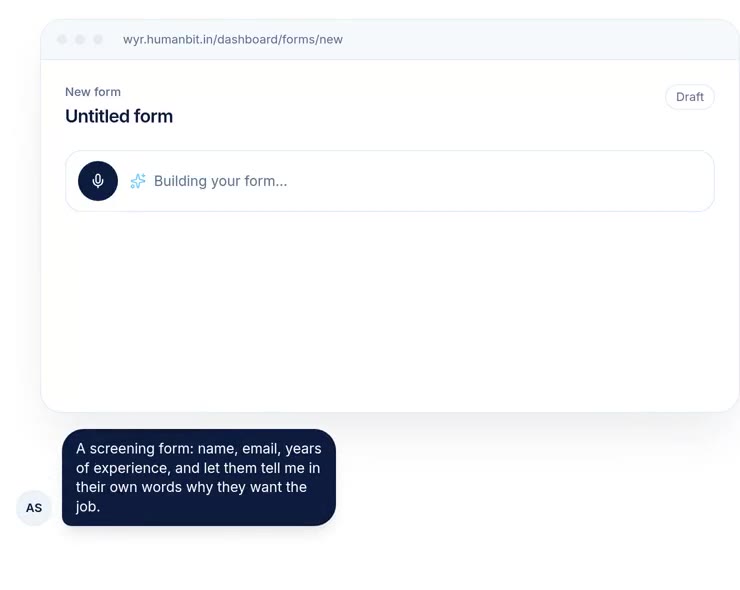
WYR is a form builder that listens. Respondents see one question per screen in their phone browser, with no app. You can record each question in your own voice, and respondents can answer with a voice field that has a minimum and maximum length you set.
You can switch on a "type instead" box for any voice question; it is off by default. Answers land in a results view and can sync live to Google Sheets with audio links, or export as CSV. You can share by QR code, accept anonymous answers without sign-in, add section-level branching, and pull or push responses through a per-form API key.
What WYR does not do matters as much. It does not transcribe answers, run sentiment analysis or write summaries. It has no respondent panel and no AI follow-up questions. We would rather say that plainly here than have you find out after 500 recordings.
Voiceform vs Would You Rather, side by side
Here is the comparison, row by row. Voiceform facts are from its own pricing page and homepage, read on 8 October 2026.
| Voiceform | Would You Rather | |
|---|---|---|
| Built for | AI-moderated interviews and research surveys | Collecting spoken answers in a simple form |
| Price | Lite price not published, free trial; Custom on request | Free to start |
| Answer limits | 200 answers a month on Lite; Custom above | No plan limits published |
| Recording limit | 2:30 per question on Lite | You set min and max seconds per question |
| Voice and text together | Yes, voice plus text response | Yes, optional type-instead box per question |
| Video answers | Yes, plus screen recording | Photo or video upload field only |
| Transcription and translation | Yes, AI, 50+ languages | No |
| Sentiment, themes, summaries | Yes, on Lite | No |
| AI follow-up questions | Yes, 40 a month on Lite | No |
| AI form drafting | Yes, AI survey creation | Yes, from a typed or spoken description |
| Google Sheets | Custom plan only; Zapier on Lite | Live sync with audio links |
| QR codes | Custom plan only | Yes |
| Compliance listed | SOC 2 Type 2 on Lite; HIPAA on Custom | None claimed |
| Respondent panel | Yes | No |
| Where the other tool wins | Use WYR if budget is near zero and you will listen yourself | Use Voiceform if you need analysis, panels or compliance |
The table leans one way on analysis and the other way on cost and simplicity. That is the real decision.
Where Voiceform is the better choice
Voiceform does things we do not, and some of them are hard to build yourself. If any of these describe your project, Voiceform is the stronger buy:
- You need transcripts in many languages without lifting a finger. Voiceform transcribes and translates on the starter plan. In WYR you export audio and run your own speech-to-text.
- You need analysis, not just answers. Sentiment, themes and summaries turn hundreds of recordings into something a stakeholder will read.
- You want the survey to probe. AI follow-ups ask "why" when an answer is vague. A human moderator cannot do that at scale.
- You need respondents. Voiceform can recruit from its own pool. WYR assumes you bring your audience.
- Procurement asks for compliance. Voiceform lists SOC 2 Type 2, and HIPAA on Custom. WYR claims no certifications.
We think an enterprise insights team running studies across markets should shortlist Voiceform before us. That is not modesty; it is fit.
Where Would You Rather is the better choice
WYR fits when you can listen to the answers yourself, or when the recording is the deliverable. Hiring screens, course intake, event feedback and speech-data collection all fall here. So does any team that wants to test whether voice works before paying for an analysis platform.
Three things are simpler in WYR. It is free to start, so you can run a pilot without a sales call. It syncs to Google Sheets out of the box, which Voiceform reserves for Custom. And it has QR codes with anonymous answers, which suits events and field work; see QR code forms for events. For multilingual audiences, see collecting answers in Hindi, Tamil or any language.
The price question, answered as far as the pages allow
Here is everything Voiceform's pricing page says. As of 8 October 2026, Voiceform Lite shows a "Start Free Trial" button and no price. The Custom plan says "Custom pricing" and asks you to book a call. Neither the trial length nor a monthly fee is published.
That is a common pattern for research platforms with sales teams. It is not a criticism by itself. It does mean you cannot compare cost per answer until you have a quote. Ask for three numbers on the call: the Lite monthly price, the overage policy past 200 answers, and the cost of an extra seat.
What 200 answers a month means in practice
An answer is not the same as a respondent. If your survey has 4 open questions, 200 answers could mean 50 people a month, depending on how Voiceform counts closed questions. Its pricing page does not define an answer, so ask that on the call too.
WYR publishes no plan limits, and we are not stating any here. Check the current terms on the site before a large project.
Do you need transcription and AI analysis?
This is the question that should decide the purchase. Transcription is valuable, but it is also commoditised: open-source and cloud speech engines are widely available. The analysis layer on top is where Voiceform earns its fee.
Transcription you can do yourself
If you collect audio in WYR, you can export the links and transcribe them. Höhne, Lenzner and Claassen compared two engines on real smartphone survey answers. OpenAI's Whisper produced more accurate transcripts than Google's Cloud Speech-to-Text, while Google was faster, according to their 2025 paper. Their test was in German, so check accuracy in your own languages.
- 1Collect answers with a voice fieldSet a maximum length and switch on the type-instead box so non-talkers still answer.
- 2Sync to Google Sheets or export CSVEach voice answer arrives as an audio link next to the respondent's other answers.
- 3Run the audio through a speech-to-text engineWhisper or a cloud API. Batch the files rather than transcribing one by one.
- 4Spot-check by ear before quotingListen to a sample, especially accents and mixed-language answers, before you trust a transcript.
- 5Code themes yourself or with an LLMThis is the step Voiceform automates. Budget the time honestly before choosing the manual route.
Steps 3 to 5 are real work. For 50 answers, they take an afternoon. For 5,000 answers a month, they become a job, and that is where paying Voiceform starts to make sense. We cover the export route in sending form responses to Google Sheets.
AI follow-up questions help, at a small cost
Voiceform's AI probing has research behind the general idea. Barari and colleagues tested AI chatbots that conduct conversational interviews in a web survey. With 1,800 participants, they found open-ended answers became more detailed and informative, with a slight cost to respondent experience. The preprint has not yet been peer reviewed, and it did not test Voiceform specifically.
We think probing is the most interesting thing Voiceform does. It is also the feature most likely to annoy a respondent if overused, so treat the 40 follow-ups a month on Lite as a budget to spend on your best question.
Voice needs a text fallback, in either tool
Neither tool escapes the basic trade-off. People say more when they speak, and fewer people agree to speak. In a randomised study, Claassen and colleagues asked German panel members whether they would join a survey with different answer methods.
Willingness dropped from 67% for typed answers to 47% for voice recordings. An earlier study by Lenzner and Höhne (2022) put voice willingness at about 40% of 2,146 panel members, with a preference for writing as the most common reason to refuse.
Both tools let respondents type instead. Voiceform has a voice plus text response type; WYR has a type-instead switch on each voice question. Use it. We go further into the drop-off evidence in our guide to voice surveys and spoken answers.
Where this comparison is weakest
We compared published features, not lived use. We did not run a Voiceform trial for this post, so we cannot speak to transcription accuracy, speed, or how the AI follow-ups feel to a respondent. Voiceform's comparison table also has one inconsistency: it marks "Branding Removal" as Custom only but "Remove Voiceform branding" as included on Lite. Ask on the call.
The research is narrower than the tools. The willingness figures come from German online panels and measure stated intentions. The Whisper comparison was in German. The AI interviewing study is a preprint. None of them tested either product.
Finally, we make WYR, so read our side of the table with that in mind. We have tried to concede every row where Voiceform is stronger, and there are several.
Which one to try first
If you are not sure voice will work for your audience, start free. Build one voice question with the type-instead box on in WYR, send it to 30 people, and listen to every answer. If you find yourself wishing for transcripts and themes by answer 50, that is your signal to get a Voiceform quote.
If you already know you will collect thousands of answers in several languages and need a report at the end, skip the pilot and book the Voiceform call. Bring the three pricing questions above. For the rest of the market, including video-first options, see the best voice survey tools and our Would You Rather vs VideoAsk comparison.
References
- Voiceform, Pricing, accessed 8 October 2026. Used for plan names, answer and recording limits, seats and the full feature comparison table.
- Voiceform, Homepage, accessed 8 October 2026. Used for the product description, 50+ languages, automatic transcription and theming, respondent pool and compliance claims.
- Claassen, J., Lenzner, T., Höhne, J. K. and Ziller, C., A Survey Mode of the Future? Investigating Respondents' Willingness to Participate in Self-Administered Video-Based Web Surveys, Methods, Data, Analyses 20(1), 2026 (published online 2025). Used for willingness by answer method.
- Lenzner, T. and Höhne, J. K., Who Is Willing to Use Audio and Voice Inputs in Smartphone Surveys, and Why?, International Journal of Market Research 64(5), 2022. Used, from the abstract, for voice willingness and reasons for refusal.
- Höhne, J. K., Lenzner, T. and Claassen, J., Automatic speech-to-text transcription: evidence from a smartphone survey with voice answers, International Journal of Social Research Methodology, published online 1 January 2025. Used, from the abstract, for the Whisper and Google comparison.
- Barari, S. and colleagues, AI-Assisted Conversational Interviewing: Effects on Data Quality and Respondent Experience, arXiv preprint, 2025. Used, from the abstract, for the effect of AI follow-ups on answer detail.
The weakest point in this source base: Voiceform's facts come from its own marketing pages, which we could not verify by using the product.
Questions people ask
How much does Voiceform cost?
As of October 2026, Voiceform's pricing page does not show a price. It lists two plans. Voiceform Lite offers a free trial and includes 200 answers a month, 40 AI follow-ups a month, a 2:30 recording limit per question and 1 seat. The Custom plan has custom pricing and limits, and you book a call to get a quote. Ask for the Lite price before you build anything.
Does Voiceform have a free plan?
Voiceform's pricing page offers a free trial of its Voiceform Lite plan, with a Start Free Trial button, as of October 2026. It does not describe a permanent free tier, and it does not state the trial length or the paid price. If you need a voice form that stays free while you test demand, Would You Rather is free to start.
What is the best Voiceform alternative?
It depends on what you need from the answers. If you need automatic transcription, sentiment and themes, Voiceform does that and most alternatives do not. If you mainly need to collect spoken answers cheaply and review them in a sheet, Would You Rather is free to start. If you need video answers or branching video, VideoAsk is the stronger choice.
Does Voiceform transcribe voice responses?
Yes. Voiceform's pricing page ticks AI Transcription and AI Translation on its starter plan, and its homepage says every response is transcribed, translated and themed automatically, with support for 50 or more languages. Would You Rather does not transcribe; it stores the audio and links it in your results, CSV export and Google Sheet.
Can Voiceform send responses to Google Sheets?
Not on the starter plan, going by Voiceform's own comparison table in October 2026. Google Sheets, Salesforce, HubSpot and Tableau are marked as Custom plan only. Zapier, the API, the SDK and webhooks are included on Voiceform Lite, so you could route answers to a sheet through Zapier. Would You Rather syncs answers to Google Sheets live, with audio links, on its free start.
Is a voice survey better than a text survey?
Voice gets longer, richer answers but fewer people agree to give them. In a 2023 randomised German panel study, 47% said they would answer by voice recording, against 67% who would type an answer. The best design offers voice and text side by side, so talkers can talk and everyone else can type. Both Voiceform and Would You Rather support that.
Drafted with AI from published research, then edited and approved by Apoorv Tamrkar.
Would you rather hear the answer?
Make a voice form in a minute. It’s free.
Create a form